Simpler Recycling was designed to bring consistency to household waste collections across England. A central pillar of that reform is separate weekly food waste collections.
TEEP assessments and approved exceptions are playing a significant role in how, and when, that reform is implemented.
While TEEP provides an essential framework for assessing technical, environmental and economic viability, it is also clear that it is slowing the rollout of a critical tool in improving recycling performance, separate food waste services supported by effective food waste liners.
Success in Wales
It is common knowledge that Wales is leading the way when it comes to recycling with the UK, and in fact the world, being the 3rd best country for recycling. Over the past 2 decades they have shot up from being named one of the worst, with a shocking 4.8% recycling rate in 1998, to now being on top, with a rate of 68.4% in a 2024/25 survey . So it was time for England to follow suit, and take charge of their recycling, and thus the introduction of Simpler Recycling. The way local authorities in Wales collect waste is highly consistent and aligned with the principles of Simpler Recycling, and, most importantly, every council in Wales collects food waste separately. Studies prove that once separate collections for food waste were introduced, other forms of separate recycling also improved – mainly due to reduced contamination and better understanding of ‘which bin is best’.
So, with Wales as inspiration, the Simpler Recycling plans went ahead with the help of the Environment Act 2021 and DEFRA. Yet, despite the length of implementation, it seems many councils will not be implementing the Simpler Recycling rules, so let’s investigate as to why.
TEEP and Exceptions, Why Are Councils Delaying?
TEEP, Technically, Environmentally and Economically Practicable, exists to ensure reforms are deliverable at a local level. Councils must consider infrastructure capacity, long term treatment contracts, fleet requirements and financial constraints. These are not minor considerations. They shape operational resilience and public accountability.
However, where extensions have been granted, the implementation of separate food waste collections is being deferred. And when food waste collections are delayed, the widespread adoption of food waste liners is also delayed. This matters because food waste is a substantial component of the household waste stream. Capturing it separately has a measurable impact on recycling rates and contamination levels. TEEP is supporting careful planning. But it is also extending the timeline for change.
Why Food Waste Liners Are a Critical Tool?
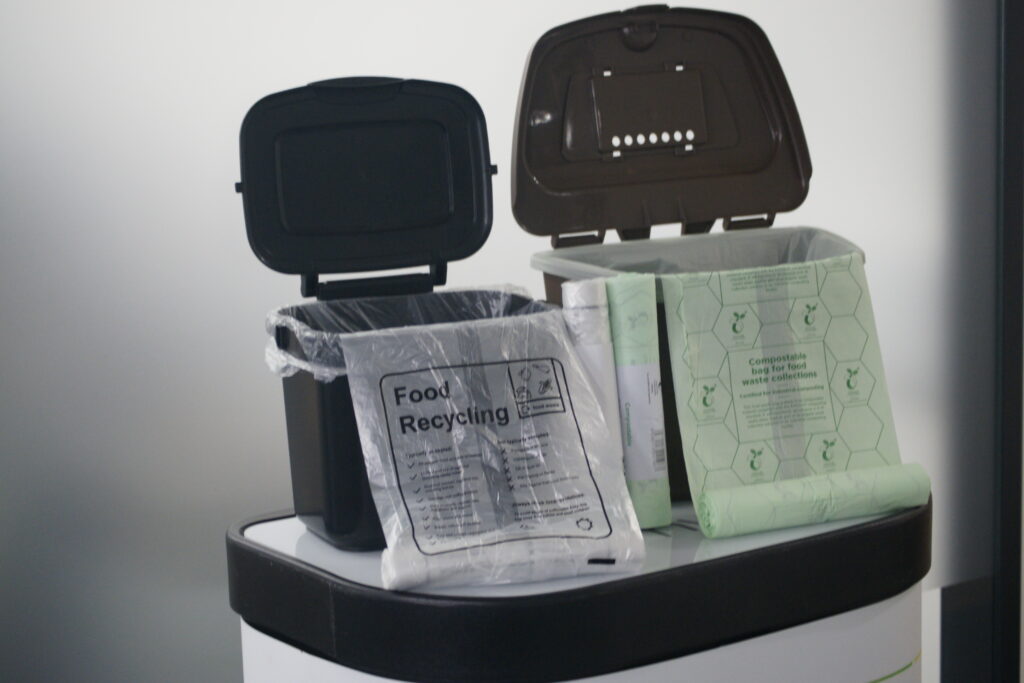
Food waste liners are not a peripheral product. They are a practical enabler of separate food waste collections.
Without appropriate liners:
- Kitchen caddies are harder to manage hygienically
- Leakage and odour concerns increase
- Resident participation can decline
- Contamination risks rise
With suitable food waste liners in place, authorities can:
- Improve household engagement
- Support cleaner organic waste streams
- Reduce rejected loads
- Enhance overall recycling performance
Delays to food waste collection services therefore mean delays to these operational and environmental gains.
Currently, 31 local authorities have been granted extensions, which results in 15% of English councils that are now missing the initial deadline. Some contracts have been extended to dates as far in the future as 2043 (as stated in a recent Talking Rubbish Podcast), 17 years past their intended inception date, and it is Yorkshire that sees the highest number of councils pushing the dates back.
Turning Policy into Practical Progress
For decision makers, the focus is rightly on service quality and value. Food waste liners form part of that equation. They must be fit for purpose, durable and compatible with the intended processing method. They must support residents in participating confidently and hygienically. And they must be supplied reliably.
At Cromwell Polythene, our role is to support that transition with dependable, compliant and practical solutions that help local authorities achieve both operational and environmental objectives.
TEEP may be influencing the pace of change. But the direction remains clear. Separate food waste collections are central to improved recycling performance. When those services expand, food waste liners will remain one of the simplest, most effective tools in making them work.