At Cromwell, cutting carbon emissions is not a footnote to our business. It is part of our responsibility. Every one of our food waste liners is designed to do more than simply line a bin. It plays a practical role in capturing food waste and steering it away from landfill and into recycling processes such as composting and anaerobic digestion.
When food waste is sent to landfill, it breaks down without oxygen and releases greenhouse gases. When it is separated correctly at source, it becomes a resource. It can generate renewable energy, create soil improvers and contribute to a more circular economy. That transformation often starts with something simple and overlooked: a reliable liner.
By helping organisations separate waste at source, our food waste liners reduce contamination, improve recycling rates and significantly cut the carbon dioxide emissions that would otherwise be generated in landfill. We promote their use not only for hygiene and convenience, but because when food waste is managed properly, it stops being a problem and starts being part of the solution.
Examining Compostable Food Waste Liners
Let us look at our best selling product of the year, the 7L Compostable Liner, product code CW007C0.
In 2025, we sold 68,065 cartons for food and organic waste collections. That equates to 141,575,000 individual liners potentially being used, filled and collected. Those are not just numbers on a spreadsheet. They represent millions of small, daily actions that collectively make a serious environmental difference.
Each 7L liner can hold an average of 4.64 kg of food or organic waste. Multiply that by the number of liners sold in 2025 and you arrive at an estimated 656,908 tonnes of food waste potentially diverted from landfill.
Now consider the carbon impact.
It is estimated for every 290.5 tonnes of food waste collected, 174.3 tonnes of CO2e can be saved by diverting food waste from landfill. That is roughly equivalent to taking 55 cars off the road for a year. In simple terms, every tonne of food waste diverted can save around 0.6 tonnes of CO2e.
Based on these figures, our CW007C0 food waste liners could represent a potential saving of approximately 394,144.8 tonnes of CO2e from just one year of supply. That is the power of consistent, correct waste segregation, supported by the right products.
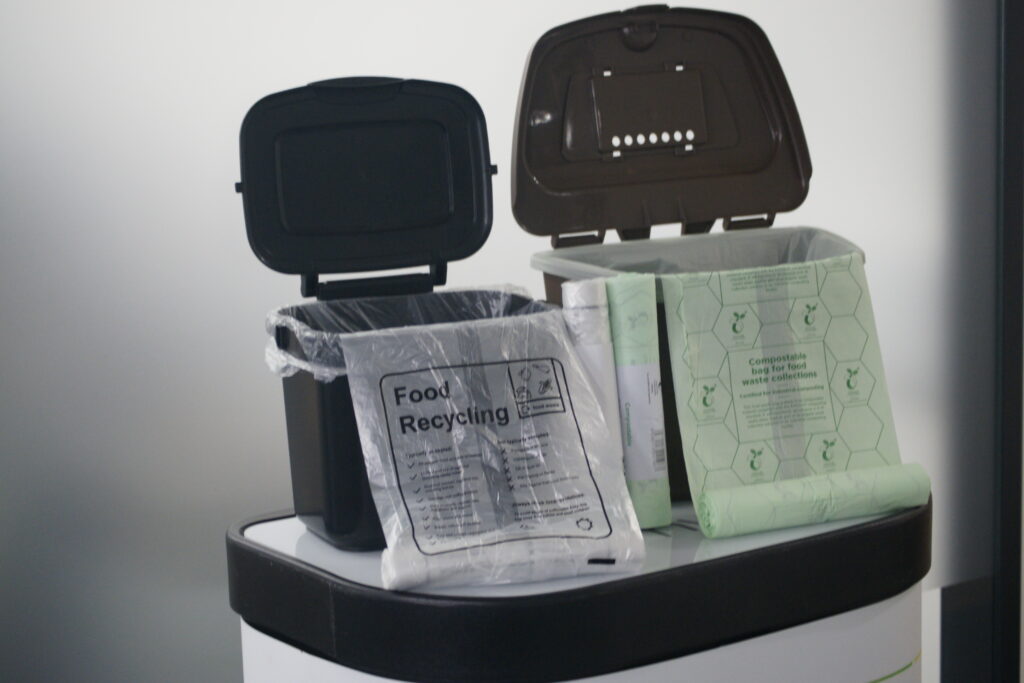
What about Polythene Food Waste Liners?
Compostable liners are not the only option in our range. Our standout newcomer for 2025 was our polythene food caddy liner, product code NA007G0. Designed as an alternative to compostable bags, this new addition has quickly gained traction and is already leaving our warehouse in significant volumes.
Since its launch early last year, we have sold 6,602 cases, equating to 27,464,000 liners.
These polythene food waste liners are manufactured to a thinner micron than their compostable counterparts and can hold an average of 2 kg of food waste. If used to their full capacity, the liners sold could have supported the diversion of approximately 55,292 tonnes of food waste from landfill.
Applying the same carbon calculation, this equates to a potential saving of around 33,175.2 tonnes of CO2e.
Different materials. Different specifications. The same fundamental objective: keeping food waste out of landfill and in the recycling stream.
The Bottom Line
For decision makers in local authorities, facilities management and waste management companies, the choice of food waste liners is not simply a procurement exercise. It is a practical lever for improving recycling performance, reducing contamination and cutting measurable carbon emissions across your collections.
Specifying the right liners for residents, commercial premises or managed facilities can increase participation and support compliance with food waste legislation.
When multiplied across thousands of households or multiple sites, the cumulative effect is substantial. Tonnes of food waste diverted. Tonnes of CO2e avoided. Clear progress towards carbon reduction targets and sustainability commitments.
Sometimes, achieving large-scale environmental gains does not require radical change. It requires consistent systems, reliable products and informed purchasing decisions. The right food waste liners, supplied at scale, are a simple but powerful part of that strategy.