When people think about NHS waste, they usually picture the brightly coloured clinical waste sacks, filled with needles, bandages and other medical waste, which require specific end-of-life treatment.
But that is only part of the story.
Behind every hospital corridor, outpatient clinic, office block, canteen, and care facility sits a much larger, quieter waste stream. The kind generated by large amounts of meals, packaging, and other everyday waste items. It is the unheard of waste of the NHS. Managing this non-clinical waste properly is essential for cleanliness, sustainability, operational efficiency, and recycling targets. This is where a CHSA-accredited refuse and compactor sack can play an important role.
Why CHSA accreditation matters
The Cleaning and Hygiene Suppliers Association (CHSA) operates an Independent Certification Scheme for refuse sacks and compactor sacks. This means products are independently tested to ensure they meet their stated specification for size, weight, and performance – aka ‘what’s on the box, is in the box’.
Healthcare environments operate under greater scrutiny than almost any other sector, and as such, reliability matters.
Products used across NHS facilities must support safety, reliability, and compliance. As such, procurement teams need confidence not only in product performance but also in supplier credibility and transparency. A poor quality sack that tears or leaks can lead to contamination, increased handling time, health and safety risks, and recyclable waste being redirected into general waste streams.
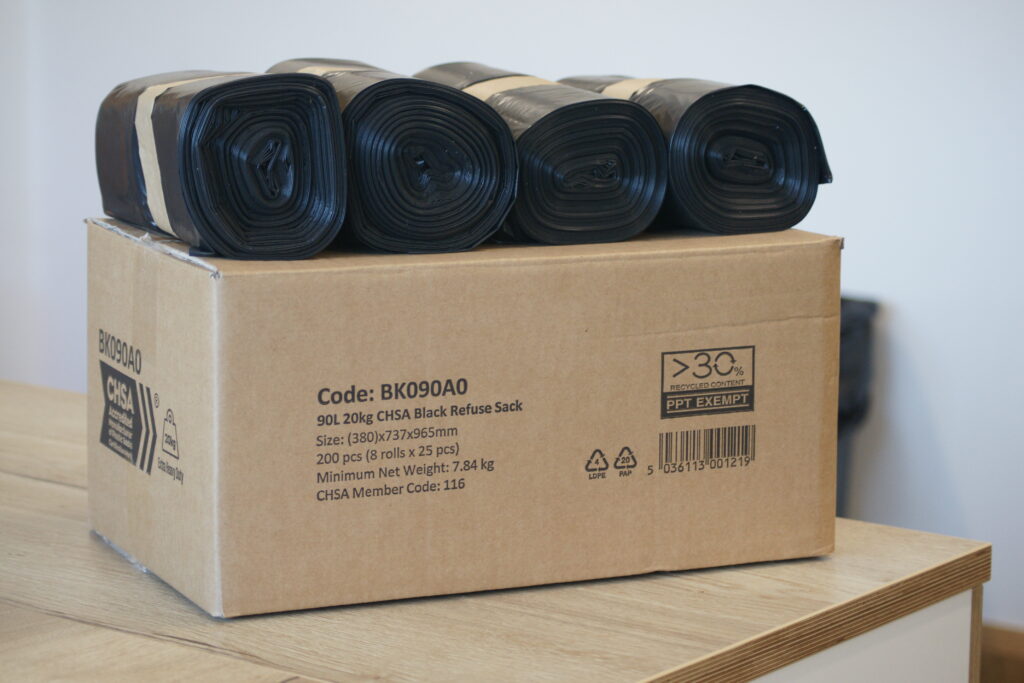
So by choosing CHSA-accredited sacks, NHS procurement teams can be confident that the products they buy will perform consistently in demanding environments.
Supporting NHS sustainability goals
The NHS continues to strengthen its sustainability and recycling commitments as part of its wider Net Zero ambitions. Reducing waste, improving recycling rates, and supporting circular economy principles are all key priorities. Having reliable refuse and compactor sacks plays an important role in helping facilities achieve these objectives by:
• Improving waste segregation
• Reducing contamination in recycling streams
• Preventing unnecessary double bagging
• Supporting efficient waste handling processes
• Reducing avoidable product waste caused by sack failure
In busy healthcare environments, consistency is critical. Waste management systems only work properly when every part of the process performs as expected.
Cromwell Polythene and CHSA accreditation
As a CHSA member, Cromwell Polythene supplies refuse and compactor sacks designed to support demanding sectors, including healthcare.
By combining product reliability with a focus on resource efficiency, Cromwell helps organisations improve waste management processes while supporting sustainability objectives.
While refuse sacks may not attract much attention, they are a vital part of keeping NHS facilities clean, efficient, and operational every single day.
Final thoughts
While clinical waste often takes the spotlight, the NHS also manages huge volumes of general and recyclable waste every day. Reliable CHSA-accredited refuse and compactor sacks help healthcare facilities improve efficiency, support recycling goals, and maintain cleaner, safer environments.
Because in healthcare, even the smallest details matter.